Open-Access-Publikationsfonds in Deutschland

Ich bin gerade dabei, eine Liste der mir bekannten Open-Access-Publikationfonds in Deutschland zu erstellen. Ergänzungen und Anmerkungen sind willkommen.

Eine hilfreiche Definition des Begriffes „Open-Access-Publikationsfonds“ bietet  die Scholarly Publishing and Academic Resources Coalition (SPARC):

An open-access fund is a pool of money set aside by an institution or other research-sponsoring entity specifically to defray or cover processing fees for articles published by members of the institution in open-access journals. While open-access funds are administered in a variety of fashions with a wide array of policy distinctions, they share a common goal of encouraging researchers to make their work open to the public. (Quelle.)

Die folgende Liste vereinigt deutsche Institutionen, die einen Open-Access-Publikationsfonds betreiben und unter diesem Begriff kommunizieren:

Die Mehrzahl der genannten Institutionen werden durch das Förderprogramm „Open-Access-Publizieren“ der Deutschen Forschungsgemeinschaft (DFG)  gefördert.

Eine Übersicht von Open-Access-Publikationfonds weltweit bietet das Open Access Directory (OAD).

Folien des DINI/Helmholtz Repositorien Workshop online

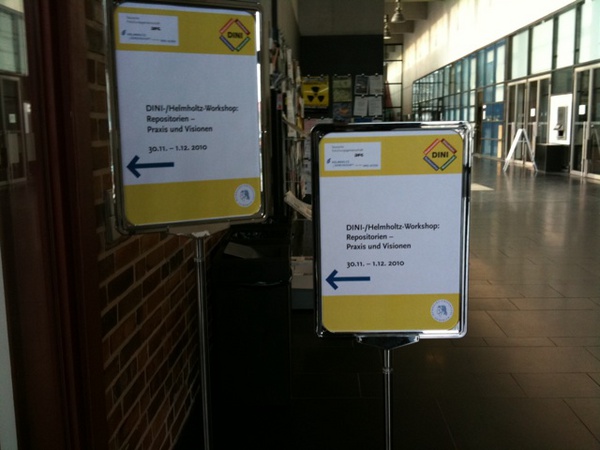
Vom 30.11. bis 01.12.2010 veranstaltete das Helmholtz Open Access Projekt in Zusammenarbeit mit der Deutschen Initiative für Netzwerkinformation (DINI) im Erwin Schrödinger-Zentrum des Universitätscampus in Berlin-Adlershof einen Workshop zur strategischen Weiterentwicklung von Repositorien. Über 130 Teilnehmerinnen und Teilnehmer aus Wissenschaft, Infrasturktureinrichtungen und Verlagen informierten und diskutierenden über die zukünftige Rolle von Repositorien in Forschung und Lehre.

Die Folien der Veranstaltung sind auf der DINI-Website zugänglich. Eine „Dokumentation“ der Veranstaltung ist bei Twitter (#dinihg10) zu finden.

Knowledge Exchange: Reports zu Open Access

Im Rahmen der „Knowledge Exchange“ Initiative wurden zwei interessante Reports zu Open Access veröffentlicht:

Friend, F.: Impact of Open Access outside European universities. Knowledge Exchange, 2010. Online.

This briefing paper explores the impact of open access upon potential users of research outputs outside the walls of research-led European universities, where the economic value of open access may be even greater than the academic value within universities. The potential impact of open access is understood in many communities but requires a greater volume of open access content to be available for the full potential to be realised. More open access content will become available as the opportunities in open, internet-based digital scholarship are understood.

Ware, M.: Submission Fees – A tool in the transition to Open Access?. Knowledge Exchange, 2010. Online.

Based on the interviews and the modelling in the study one model in particular is regarded as the most suitable way to meet the current requirements (i.e. to strengthen open access to research publications). In this model authors pay a submission fee plus an Article Processing Fee and the article is subsequently made available in open access. Both fees are set at levels that balance acceptability with the author community with securing a meaningful mix of revenues for the Publisher.

Knowledge Exchange ist eine Netzwerk von vier europäischen Förderern: Denmark’s Electronic Research Library (DEFF), Deutsche Forschungsgemeinschaft (DFG), Joint Information Systems Committee (JISC) und  SURFfoundation.

Neelie Kroes: The Challenge of Open Access

Die  Rede der EU-Kommissarin für die „Digitale AgendaNeelie Kroes zum heutigen Launch von OpenAIRE ist sehr lesenswert. Ein Auszug:

The right to access freely the results of science does not only benefit citizens but also the public funding bodies. I believe public scrutiny of research results will improve how we allocate research funds. It will also increase the citizens‘ confidence in research spending. The long-term effect will be to help governments to make the investments we need to secure a sustainable and inclusive future. Open access can thus be understood as supporting the Open Government principle, helping to bring about better public services.

Open access is a legal and technical reality today. The question is no longer ‘if’ we should have open access. The question is about ‘how’ we should develop it further and promote it.

This „how“ is indeed a challenge. It is an organisational and business challenge as the internet revolution disrupts the established models for scholarly dissemination. Open access is also a social challenge. As with all revolutions, the privileges of gatekeepers are revealed and put in doubt. Both knowledge producers and gatekeepers– the publishers and those doing the science – are forced to rethink their roles. All stakeholders will need to participate in this change. Also the funding bodies have an important role because they must ensure that deposit obligations are honoured.

Im Rahmen des OpenAIRE Projekts wird eine Infrastruktur aufgebaut, um das Open-Access-Pilotprojekt der Europäischen Kommission zu unterstützen. Das Transkript der Rede ist online.


PKP Scholarly Publishing Conference 2011 in Berlin

Das Public Knowledge Project, bekannt unter anderem durch die Entwicklung von Open Journal Systems, wird 2011 zum ersten Mal außerhalb von Kanada seine jährliche Konferenz abhalten, und zwar in Berlin. In Zusammenarbeit mit dem CeDis werden vom 26-28 September 2011 an der FU Berlin internationale Projekte und Initiativen zu den Themen Open Access und wissenschaftliches Publizieren vorgestellt. Man kann desweiteren vermuten, dass die Weiterentwicklung von OJS eine zentrale Rolle spielen wird. Aus dem Call for papers:

The Third International PKP Scholarly Publishing Conference
Building and Sustaining Alternative Scholarly Publishing Projects Around the World

The Public Knowledge Project is pleased to announce that, in partnership with the Freie Universität Berlin, the Third International PKP Scholarly Publishing Conference will be held from September 26 – 28, 2011 in Berlin, Germany. This is the first time that the PKP Conference is being held outside of Vancouver, Canada, and we look forward to meeting more members of the growing, international PKP user community. Given that the landmark Budapest Open Access Initiative, launched in December 2001, will be celebrating its first decade, the conference invites explorations of the lessons learned, successes achieved, and setbacks overcome in our shared attempts to increase and open access within scholarly publishing. The first and second PKP conferences brought together a remarkable array of presentations and participants from around the world, and we anticipate an equally valuable experience in 2011.

Proposals that address one or more of the following topics are especially encouraged:

* New reading and publishing technologies, e.g., integration of Web 2.0 features;
* Reports on national and regional open access policies and initiatives;
* Alternative publishing and funding models;
* National and international collaborative projects;
* New roles and partnerships for libraries, scholarly publishers, and others;
* Sustainability for open access publishing and open source software.

The conference will consist of a mixture of plenary presentations, panel discussions, brief „lightning talks,“ posters, workshops, a hackfest, an exhibitor hall, and parallel conference sessions in the following streams:

* Editors, publishers, and librarians
* Researchers and members of scholarly/scientific societies
* Software developers and system administrators
* Community/User groups

Parallel sessions will each be up to 20 minutes in length. Lightning Talks and “Ask a Developer” presentations are limited to 5 minutes each. Sessions may consist of a case study, a research report, a „big idea“ in publishing, as well as other options.

Proposals (500 word maximum) should be submitted by March 15, 2011, using the submission guidelines and form available on our web site. All proposals will be subject to peer-review and you will be informed of a decision by June 1, 2011. Due to the strong interest in this year’s conference, only a limited number of sessions will be accepted.

Submission Formats

1. Papers (20 minutes)
Standard conference papers, to be presented at the conference, with the paper posted to the PKP Conference web site.

2. Presentations (20 minutes)
Standard conference presentation, without an accompanying paper. The presentation file (e.g., Powerpoint) will be posted to the Conference web site.

3. Panels (20 – 50 minutes, depending upon number of panelists)
Standard conference panel session, with the time length determined by the number of panelists. All presentation files will be posted to the Conference web site.

4. Posters
A poster to be displayed in the common space. The poster file will be posted to the Conference web site.

5. Lightning Talks (5 minutes)
Very brief presentations: 5 slides in 5 minutes.The presentation file (e.g., Powerpoint) will be posted to the Conference web site. Topics could include a new feature development, or a case study of a current project (local, regional, national, international) using one or more of the PKP software applications.

6. “Ask a Developer” Presentations (5 minutes)
Very brief (5 minute) presentations illustrating a particular problem, issue, or need with one or more of the PKP software applications, made to an open audience, but also to members of the PKP development team. PKP Team members will respond to each presentation with suggestions, recommendations, or opportunities for further collaboration.

The Public Knowledge Project is a research and development initiative directed toward improving the scholarly and public quality of academic research through the development of innovative online publishing and knowledge-sharing environments. Located at the University of British Columbia, Simon Fraser University, and Stanford University, PKP has developed free, open source software for the management, publishing, and indexing of journals and conferences. Software such as Open Journal Systems, Open Conference Systems and Open Monograph Press increase access to knowledge, improve management, and reduce publishing costs. Over 6500 online journals worldwide are currently using the OJS software.

Ars Technica zum Thema Forschungsdaten

Auf Ars Technica hat John Timmer eine interessante Serie von Artikeln zur dauerhaften Zugänglichkeit von Forschungsdaten veröffentlicht:

Teil 1: Preserving science: what to do with raw research material?

Teil 2: Preserving science: what data do we keep? What do we discard?

Teil 3: Jaz drives, spiral notebooks, and SCSI: how we lose scientific data

Diese und weitere interessante Hinweise zum Thema können auf der DFN-Mailingliste „Umgang mit Forschungsdaten“ gefunden und diskutiert werden.

Access to Knowledge in the Age of Intellectual Property

Gefödert vom Open Society Institute (OSI) haben Amy Kapczynski und Gaëlle Krikorian eine interessante Sammlung von Essays rund um den offenen Zugang zu Information und Wissen veröffentlicht. Access to Knowledge in the Age of Intellectual Property umfasst auf über 600 Seiten Beiträge von mehr als 60 Autoren. Dabei wird das Thema aus unterschiedlichsten Perspektiven beleuchtet. Auszug aus der Ankündigung:

At the end of the twentieth century, intellectual property rights collided with everyday life. Expansive copyright laws and digital rights management technologies sought to shut down new forms of copying and remixing made possible by the Internet. International laws expanding patent rights threatened the lives of millions of people around the world living with HIV/AIDS by limiting their access to cheap generic medicines. For decades, governments have tightened the grip of intellectual property law at the bidding of information industries; but recently, groups have emerged around the world to challenge this wave of enclosure with a new counter-politics of „access to knowledge“ or „A2K.“ They include software programmers who took to the streets to defeat software patents in Europe, AIDS activists who forced multinational pharmaceutical companies to permit copies of their medicines to be sold in poor countries, subsistence farmers defending their rights to food security or access to agricultural biotechnology, and college students who created a new „free culture“ movement to defend the digital commons. Access to Knowledge in the Age of Intellectual Property maps this emerging field of activism as a series of historical moments, strategies, and concepts. It gathers some of the most important thinkers and advocates in the field to make the stakes and strategies at play in this new domain visible and the terms of intellectual property law intelligible in their political implications around the world.

Die Publikation ist hybrid erschienen. Die Online-Version ist auf soros.org als PDF im Open Access zugänglich.

Literatur:

Krikorian, G. ; Kapczynski, A.: Access to knowledge in the age of intellectual property. New York : Zone Books, 2010.

Workshop zur Zukunft von Open-Access-Repositorien

In eigener Sache: In Zusammenarbeit mit der Deutschen Initiative für Netzwerkinformation (DINI) veranstaltet das Helmholtz Open Access Projekt vom 30.11. bis 01.12.2010 in Berlin-Adlershof (Erwin Schrödinger-Zentrum) einen Workshop zur strategischen Weiterentwicklung von Open-Access-Repositorien.

In Deutschland haben sich die Repositorien Ende der 90-er Jahre entwickelt. Unter dem Namen Hochschulschriften- oder Dokumentenserver entstanden Datenbanken, auf denen Hochschulschriften als Erst- oder Zweitveröffentlichung zugänglich gemacht wurden.

Mit der Entwicklung von Open Access wurden diese Datenbanken international unter dem Begriff Repositorien bekannt und Grundlage des „Grünen Weges“ des Open Access. Prominentes Beispiel ist das arXiv, welches 1991 am Los Alamos National Laboratory aufgebaut wurde und bis heute das zentrale Repositorium  für Preprints in den Disziplinen Physik, Mathematik und Informatik ist.

Im Bereich der außeruniversitären Forschung wurde spätestens Mitte der Nullerjahre begonnen, die seit langem bestehenden institutionellen Publikationsdatenbanken, die ausschließlich Metadaten nachweisen, zu Repositorien auszubauen, um Pre- und Postprints sowie Schriftenreihen im Open Access zugänglich zu machen. Eine Entwicklung, die im universitären Bereich erst langsam aufgegriffen wird.

Zudem sind in den letzten Jahren abseits der Text-Repositorien auch Repositorien für unterschiedlichste Formen und Formate digitaler Objekte entstanden, z.B. für Forschungsdaten.

Heute stehen Repositorien vor einer Vielzahl von Herausforderungen. Mehrheitlich werden sie immer noch als passive Dienste betrieben, die nicht in den Arbeitsablauf von Wissenschaftlerinnen und Wissenschaftlern eingebunden sind. Darüber hinaus steigen mit der Entwicklung der digitalen Wissenschaften die Anforderungen an die Repositorien (beispielsweise im Kontext virtueller Forschungsumgebungen).

Der DINI-/Helmholtz-Workshop „Repositorien – Praxis und Vision“ wird neben dem Blick auf den Stand der Repositorien an Hochschulen und außeruniversitären Forschungseinrichtungen auch folgende Themen behandeln:

  • Zusammenspiel von institutionellen und disziplinären Repositorien
  • Zusammenspiel von Forschungsdaten- und Text-Repositorien
  • Repositorien und Forschungsinformationssysteme (CRIS)
  • Repositorien und Soziale Netzwerke in der Wissenschaft

Ziel der Veranstaltung ist es, Impulse für die Weiterentwicklung der Repositorien zu geben. Während am ersten Tag Vorträge im Plenum stattfinden, widmet sich der zweite Veranstaltungstag in Sessions unterschiedlichsten Aspekten des Themenfeldes.

Programm und Anmeldung für den DINI-/Helmholtz-Workshop „Repositorien – Praxis und Vision“.

Empfehlungen zur IT-Infrastruktur in Forschung und Lehre

Die Kommission für IT-Infrastruktur (KfR) der Deutschen Forschungsgemeinschaft (DFG) hat im Oktober Empfehlungen zur IT-Infrastruktur in Forschung und Lehre veröffentlicht. Auszug aus der Pressemitteilung:

“Für den Erfolg von Hochschulen und Universitätsklinika im nationalen und internationalen Wettbewerb muss die IT-Infrastruktur für Forschung, Lehre, Organisation und Krankenversorgung effizient ausgestaltet sein. Wie dies in Zukunft geschehen kann, zeigen die von der Deutschen Forschungsgemeinschaft (DFG) herausgegebenen neuen Empfehlungen der Kommission für IT-Infrastruktur (KfR), die jetzt unter dem Titel „Informationsverarbeitung an Hochschulen – Organisation, Dienste und Systeme“ erschienen sind, für den Zeitraum von 2011 bis 2015. Wie wichtig dies ist, betont auch DFG-Präsident Professor Matthias Kleiner in seinem Vorwort: ‘Informationstechnik ist zum unverzichtbaren Teil jeder Forschungsinfrastruktur, Information zu einem zentralen Standortfaktor für Wissenschaft und Wirtschaft geworden.’”

Die Empfehlungen sollen Antragsteller, Hochschulleitungen sowie weiteren Akteuren in Bund und Ländern “einen Entscheidungshilfe bei der nachhaltigen Gestaltung IT-relevanter Prozesse an Hochschulen geben”.

Literatur:

Deutschen Forschungsgemeinschaft: Informationsverarbeitung an Hochschulen – Organisation, Dienste und Systeme. Empfehlungen der Kommission für IT-Infrastruktur für 2011–2015. Bonn, 2010. Online.

Open Data vs. Open Access to Research Data

Jens Klump hat unter dem Titel „Open Data und Open Access to Data – Die ungleichen Geschwister“ auf den diesjährigen Open-Access-Tagen einen schönen Vortrag zur Problematik des Begriffes „Open Data“ im wissenschaftlichen Umfeld gehalten. Auszug aus dem Abstract:

Die Forderung nach einem offene Zugang zu Daten erfährt in der öffentlichen Diskussion mehr und mehr Beachtung. Aber handelt es sich bei Open Data und Open Access to Data um ein und das selbe? Tatsächlich sind die Motivation und die Entstehungsgeschichte hinter Open Access und Open Data sehr unterschiedlich. Open Data fordert vor allem den Zugang zu Daten staatlicher Stellen. Aber auch im Kontext der Wissenschaft wird intensiv diskutiert, wie mit Forschungsdaten umgegangen werden soll. Hat die Öffentlichkeit Anspruch auf Zugang zu Daten aus öffentlich geförderter Forschung? In der Debatte um den Klimawandel spielte der Zugang zu Forschungsdaten schon eine wichtige Rolle. (Quelle.)

Die Schwierigkeit ist eine fehlende Definition des Begriffes „Open Data“. Der Eintrag in der deutschsprachigen Wikipedia zeigt, dass die Begriffsbildung noch offen ist.

Klump schlägt in seinem Vortrag vor, für den Zugang zu Forschungsdaten im Sinne des Open Access künftig von „Open Access to Research Data“ zu sprechen. Seine Vortragsfolien sind online.

Dieser Vorschlag erscheint mir wichtig und  sinnvoll. Die Herausforderungen bei der Umsetzung des offenen Zugangs zu Forschungsdaten sind häufig durch ganz spezielle und disziplinspezifische Fragestellungen gekennzeichnet. So gilt es, im Wissenschaftsbereich Reputationssysteme zu berücksichtigen, um Anreize für den „Open Access to Research“ Data zu entwickeln. Eine undifferenzierte Forderung nach „Open Data“ wird diesen vielfältigen Herausforderungen nicht gerecht.

PS: Matthias Spielkamp weist im iRights Blog auf ein Video des Elektrischen Reporters zum Thema „Open Data“  hin. (Das Video ist der Dummy für ein Video-Format namens ePolitik.)